

BMW M52/M54 Struggling to Start When Hot or Cold? Here's What to Look For
 By JEREMY PROOME on Aug 18, 2026
BMW owners with the M52 and M54 models may experience their vehicle starting (or not starting) very inconsistently. This, unfortunately, is one of the most common issues found with the models, and while some failures may be due to a problematic sensor, battery, or ignition switch, it very often leads back to the DME itself.
The ECU Pro offers affordable BMW DDE repairs and replacements through its handy mail-in service.

Things You've Probably Noticed:
We often see vehicles being reported with the following issues:
-
Car stalls while driving, with no obvious cause
-
No start, no dash lights at all
-
Intermittent crank/no-start. Sometimes it fires right up, sometimes it doesn't
-
Erratic idle
-
Throttle faults that come and go
-
An airbag light that seems unrelated to anything electrical
-
A stored valve-timing code that doesn't match the mileage or condition of the engine
-
The classic pattern: worse when cold, sometimes completely fine once warm
A DME with an internal solder fault or component problem will produce different outcomes depending on how hot or cold the board itself is. For example, a common issue is a crack forming in the board, which can expand or contract in different temperatures, sometimes allowing the car to work and other times not.
Something to keep in mind
The funny thing with these issues is that, due to the fact that they can work and not work intermittently, the DMEs sometimes don’t produce a fault code. However, if all the related components are checked with no issue found, there is a likelihood that something is wrong with the internal board.
It’s also good to know that a stressed or intermittently failing DME can throw all kinds of codes that have nothing to do with the actual fault. What matters is the internal self-test result, which is why it's important to get it tested professionally.
Why it fails
The long and short of it: age. The M52 and M54 use BMW’s MS41, MS42, MS43, and MS45 DMEs. Many of these have been exposed to years of heating and cooling, causing issues with the internal components, soldering, and circuitry of the board.
With solder damage, and cracks often forming, the result can cause the board to malfunction and cause inconsistent performance (starting and not starting), depending on how hot it is.
Another common issue is the crankshaft sensor, which the DME uses to determine engine speed/position for ignition activation. If the sensor isn't working correctly, this can cause a no-start.
How we get to the bottom of the problem
To eliminate all possibilities, we run the DME's internal self-test and look for checksum faults that simply will not clear no matter how many times we reset them. Then we cold-test the unit, and more often than not, the car starts and then stalls right after, reproducing exactly what the customer described.
In this case, because the fault is often temperature-dependent, it's therefore usually intermittent or completely absent when the module is warm, which is what points us at a failing internal processor rather than a sensor, connector, or electrical issue out in the car. However, it's always best to test thoroughly to find the real reason for the no-start.
Process of elimination
While not every issue is the same, we have seen many similar problems that always send owners down the same road to try and fix the issue: swapping the battery, valve-timer, VANOS sensor, throttle body, and resetting the airbag light.
Often, these are all just symptoms of the problem and downstream from the actual issue: the DME itself.
Of course, there are a few components which could cause the problem, such as
-
crankshaft position sensor (especially if RPM is absent during cranking),
-
camshaft position sensors,
-
fuel pump or fuel pump relay,
-
EWS immobilizer synchronization issues,
-
occasionally ignition switch problems.
But in many cases, physical damage or a thermal solder fault can cause the DME to work inconsistently. It's best to do a thorough test to narrow down the problem.
How we diagnose and repair it
Using the mail-in service, you can send your DME to us. We will do comprehensive testing and, based on the findings, offer the following options:
- Unclearable checksum faults plus a reproducible cold stall: we know the internal processor is corrupting the software; the original unit is generally not repairable at the board level, and we program a replacement DME, carry over your ISN, and align it to your car's immobiliser.
- Faults that are intermittent or only show up cold, but we can reproduce them on the bench: this is the same outcome. A replacement DME programmed and cloned to match your vehicle.
- Crank/no-start where the DME and EWS are simply out of sync (sometimes triggered by a weak battery or too many failed start attempts): We'll know that no replacement is needed at all; we resync the DME and EWS and the car starts clean.
-
No dash lights reported before the unit was even sent in: This is often a sign there's an additional issue on the vehicle side. A battery problem or the key ring not picking up the key signal is worth checking before assuming the DME alone will fix it.
Whatever issues are being produced, the diagnostic approach is the same: we aim to replicate it on the bench first, then decide whether it's a repair, a replacement, or a resync with your go-ahead before proceeding. But the first step is to test. Start your test here.
Repair vs. replacement: what to expect
If the DME problem you're experiencing is due to damage on the actual board, it may not be repairable. So, we would then move straight to a programmed replacement rather than trying to repair something that would recur anyway.
Your original ISN is copied over to the replacement and aligned with your car's immobiliser system, whether that's EWS or CAS depending on your model year. If a new key is needed to complete the process, we can cut and program one as part of the job.
If the fault turns out to be a simple loss of synchronization between the DME and EWS and we can confirm that no internal processor damage has happened, we can then resync the two modules and send the unit back without any replacement or cloning involved. It's a much simpler fix, and it's why testing matters before assuming the worst.
Proof before it ships
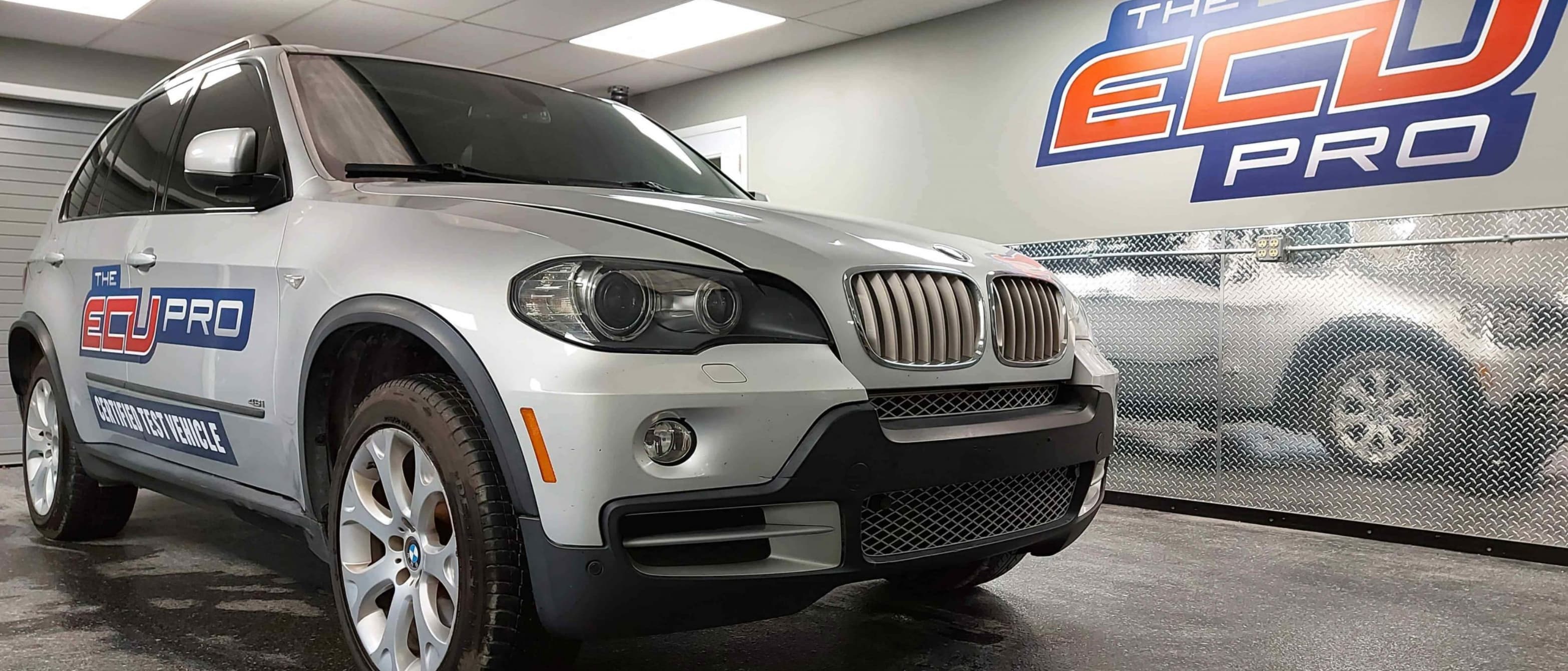
Our company policy is to show every repaired or replacement DME working as expected on a test vehicle, so you have certainty that the part is working before you receive it.
When did BMW start locking the DME to the car?
The truth is that BMW has actually been doing this for quite some time. All the M52 and M54 DMEs are locked to the specific vehicle's immobiliser, either the EWS system or, on later cars, the CAS.
There's no "unlocked" version of these DMEs floating around. That's exactly why any replacement or cloned DME has to have your original ISN carried over and aligned to your car's EWS or CAS before it will start the engine at all.
Frequently asked questions
Why does my BMW only start when the engine is cold, or only when it's warm?
As explained in some more detail above, this unusual and inconsistent engine behaviour points to a physical problem on the DME (usually a crack that expands and contracts with heat and cold). It's not something a sensor replacement fixes.
Is the original DME always replaced, or can it be repaired?
This is always down to what the testing produces. If the internal processor is corrupting the software (unclearable checksum faults), the unit is generally replaced with a programmed unit carrying your ISN. If the DME and EWS have simply lost synchronization, we resync them instead without the need for a replacement.
Do I need to send my EWS or CAS module along with the DME?
Yes, we do need your EWS or CAS for synchronisation purposes during programming.
Will I need a new key?
Sometimes. If your original key's data doesn't carry over cleanly to a replacement DME, we can cut and program a new one as part of the job. We will discover this during the testing.
My car has no dash lights at all — is that this same fault?
It could be connected, but problematic dash lights are often also the result of a poor battery or voltage issues.
Starts hot, stalls cold — or the reverse? Don't replace sensors chasing a fault that lives inside the DME. Send your M52/M54 DME in for bench testing and we'll reproduce the fault, tell you honestly whether it's repairable, and prove the fix with a test-vehicle video before it ships back.
Start your ECU/DDE testing process here!

Mail in automotive electronic repair services
The ECU Pro offers an affordable mail-in repair service for automotive electronics. To have your unit repaired, simply remove the part and mail it to us. Our professional team will either test, repair, or clone your unit.
Our team has over 30 years experience in automotive electronic repairs. We specialize in German vehicles such as BMW, Mercedes and Mini. Our main focus is engine control unit repairs ( ECU, PCM or DME). Our state of the art facility has over 30 test vehicles to ensure that all parts are tested in actual vehicles before being returned to our clients.
Most of the services we provide is plug and play and doesn't require any additional coding.