

Mini Turbo DME Repair: How to Fix Rodent Damage to Wiring
 By JEREMY PROOME on Sep 2, 2026
This may sound like a not-too-common occurrence, but you’d be surprised. The number of rodent-damaged vehicles we are called about is concerning, and when it comes to the Mini Cooper S, Clubman or Countryman (using the MEVD17, MED17.2, MEV17.2 DMEs), there are a few things to look out for.
Amongst the damage that rodents can cause are chewed harnesses, disconnected ground wires, coil shorting, injector problems, or sensor circuits being damaged.
The ECU Pro offers a mail-in service to have your Mini ECU tested, repaired, or replaced. Click here to start your testing process.

What customers often experience
Here are some of the most common symptoms customers report:
-
The car starts and idles but has no accelerator pedal response
-
Crank, but no start
-
No communication with the computer at all when a scan tool or bench tester is connected
-
Codes won't clear even after the DME has been reinstalled or reflashed
-
Multiple, seemingly unrelated system malfunctions appearing at once
-
A general sense that the DME itself is "just bad"
Now, of course, not all of the issues mentioned above are due to rats (there are a lot of things that could cause them), but if you suspect rodents got into your engine bay, there’s a likelihood they could be the culprits.
Either way, to get to a logical conclusion of what is causing the issue (whether by a rodent or another component failing), it is always best to test the module.
Common fault codes
Some of the most common Mini turbo DME fault codes include: 36E2, 28B0, 2BD2, 2F81, U1164, 2DD7, 36E3, and 27DA.
These faults often cluster around the same handful of circuits: ignition coil driver faults, injector driver faults, VANOS solenoid circuits, and loss-of-communication conditions. U1164 in particular points to a communication/data fault between modules, consistent with a DME that won't ‘talk’ at all.
However, there is something to keep in mind: a shorted or damaged DME can log a long list of codes that may have nothing directly to do with the original short. So, when a module has been damaged via the wiring, it could produce a bunch of codes or errors that have nothing to do with the problem at all.
Why it fails
This is pretty straightforward: rodents cause physical damage by chewing through insulation or wiring on the engine bay, often causing a connection, grounding, or issue whereby the DME stops communicating effectively, a sensor is damaged, or another component is damaged too.
What can happen is, if there’s an electrical short, it can travel back through the wiring into the DME module and damage the internal driver circuit responsible for switching that component. Depending on which circuit was involved and how severe the short was, the damage can be limited to a single driver, or it can take out communication with the module entirely.
While rats are a common issue, it is also possible for a ground wire that was left off the valve cover during a repair that caused the short. Again, it’s not certain, hence why it’s always best to test the DME.
Finding the problem
As always, our process is to tackle the problem by first testing the ECU you have mailed in and trying to reproduce your reported issue on one of our test vehicles.
We will try to determine whether the board itself is failing or if the board is communicating with other sensors in the car, meaning that the fault likely exists elsewhere.
Key things we check before replacing:
Before throwing the baby out with the bathwater, it’s always important to check the following:
The DME might be fine, and only malfunctioning due to an underlying wiring issue. Therefore, all of those elements must be checked before swapping out the DME.
For example, on occasion, we have found different components causing the DME to fail. If we put your module onto our bench test, and we are unable to reproduce the error, or it clears when tested directly on the board, the actual problem is somewhere else on the car. Therefore, we'll tell you that rather than sell you a repair you don't need.
What the repair actually involves
Once we have identified the problem and what component is failing, we are usually faced with the following options:
-
No communication with the DME at all: repair is usually not an option here. Therefore, we replace the DME by cloning the original to a donor DME and re-matching it to the car's immobiliser system (CAS on most of these turbo Minis, FEM on newer platform variants) so it's plug-and-play.
-
Reproducible throttle, pedal, or 5V supply faults that won't clear: Usually same outcome, a direct clone to replacement hardware.
-
A single failed driver circuit (say, one damaged by a shorted coil or injector line): Wherever possible, we’ll repair that circuit at the board level and retest.
-
Contamination on the board: we clean it and retest; no clone or chip-level repair needed if the board itself is undamaged.
-
The fault doesn't reproduce on the bench, or clears at board-level testing: the issue is on the vehicle side (wiring, ground, or another module), not the DME, and we'll say so.
In order to save you money and time, repair is always the first port of call. A clone is the fallback when the module's core functions (communication, throttle, pedal input, or the 5V sensor supply) are damaged beyond repair.
Proof before it ships
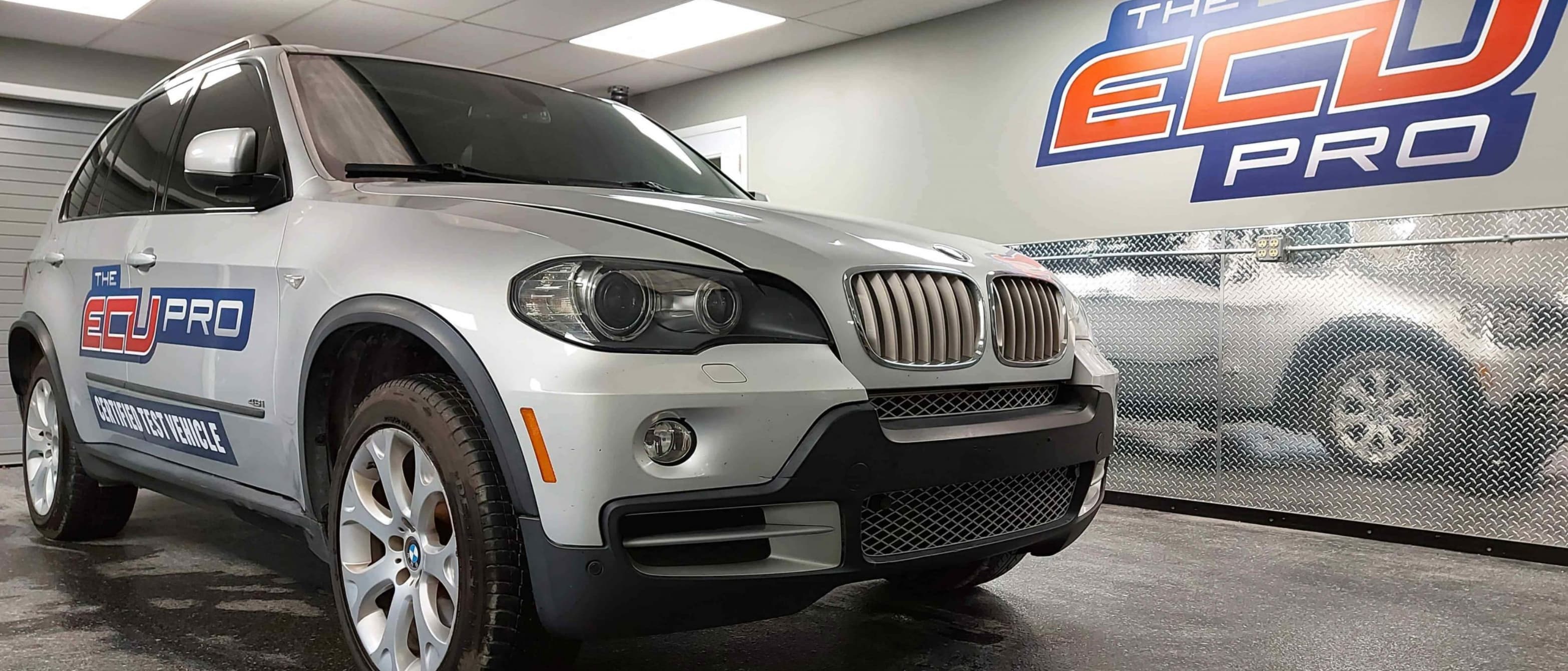
We pride ourselves at The ECU Pro by showcasing every DME working in a test vehicle before being sent back to you.
On immobiliser-related jobs, full in-car testing sometimes isn't possible without your original key and CAS/FEM module present, so we verify communication and function as far as the bench and test vehicle allow.
Frequently asked questions
Will fixing the wiring or ground issue on my car also fix the DME?
No. Once the internal driver circuit has been damaged by the short, the module won't repair itself. You need both: the wiring/ground fault fixed on the car, and the damaged DME repaired or replaced.
Do you need my CAS module or key?
Full testing of the immobiliser pairing sometimes requires your key and existing module present.
Is the repair reversible or is a clone always needed?
Not always. A good number of these units come back with a single damaged driver circuit that's genuinely repairable, especially when the short only affected one component's circuit. Cloning is reserved for units that won't communicate or show core faults that survive board-level testing.
Why does the test video show a fault code if my DME is supposedly fixed?
Our test vehicle isn't your exact car, so small mismatches between vehicles can throw a code that has nothing to do with the repair. We flag this so you're not alarmed by something that doesn't affect your car.
Suspect rodent damage or a short-circuit fault on your Mini turbo's DME? Send it in for bench testing, and we'll confirm whether it's a repairable driver fault, contamination, or a unit that needs cloning, and back it with video proof before it ships. Visit our Mini turbo DME service page to get started and confirm current pricing.
Mail in automotive electronic repair services
The ECU Pro offers an affordable mail-in repair service for automotive electronics. To have your unit repaired, simply remove the part and mail it to us. Our professional team will either test, repair, or clone your unit.
Our team has over 30 years experience in automotive electronic repairs. We specialize in German vehicles such as BMW, Mercedes and Mini. Our main focus is engine control unit repairs ( ECU, PCM or DME). Our state of the art facility has over 30 test vehicles to ensure that all parts are tested in actual vehicles before being returned to our clients.
Most of the services we provide is plug and play and doesn't require any additional coding.